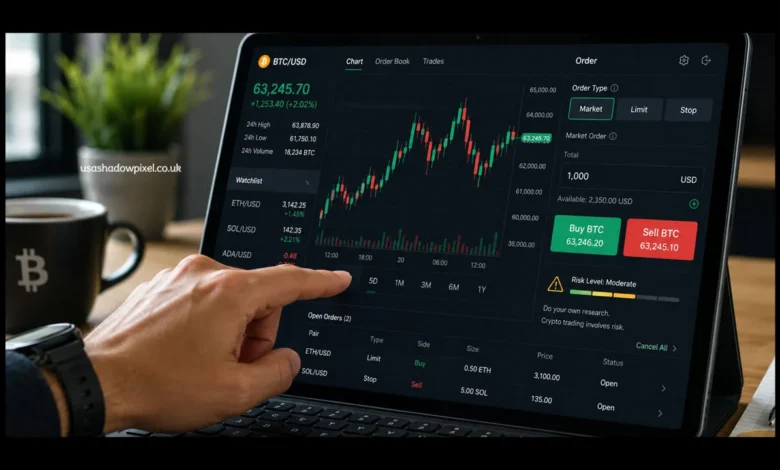
How to start trading crypto? Start by learning how cryptocurrency markets work, choosing a reputable crypto exchange, funding your account, selecting a trading approach, and learning how to control risk before placing your first trade.
Crypto trading can be exciting because digital assets can trade around the clock and prices can move quickly. However, those same price movements can produce significant losses. The CFTC warns that virtual currency markets can experience sharp price swings, fraud, hacking, and other risks, while the FCA describes cryptoassets as high-risk and speculative investments.
For that reason, successful beginners should focus less on finding a “winning coin” and more on developing a repeatable process.
Important: This article is educational information, not personalized financial, tax, or investment advice.
What Is Crypto Trading?
Crypto trading means buying and selling digital assets with the goal of benefiting from price movements.
Unlike traditional stock markets, cryptocurrency markets can operate continuously, depending on the platform and asset. Traders may buy Bitcoin (BTC), Ethereum (ETH), stablecoins such as Tether (USDT) or USD Coin (USDC), or other cryptocurrency coins and tokens.
Some commonly traded assets include:
- Bitcoin (BTC)
- Ethereum (ETH)
- XRP, associated with Ripple
- Solana (SOL)
- Cardano (ADA)
- Avalanche (AVAX)
- Tether (USDT)
- USD Coin (USDC)
- Other altcoins and tokens
Trading is different from simply holding cryptocurrency as a long-term investment. A trader may open and close positions over minutes, hours, days, or weeks, while a long-term investor may hold an asset for years.
How Does Cryptocurrency Work?
Cryptocurrency uses blockchain technology to record and verify transactions on a distributed ledger.
A blockchain is essentially a shared database maintained across a network of computers. Cryptographic techniques help protect the integrity of transactions and ownership records.
When you send crypto, the transaction is broadcast to the relevant blockchain network. Network participants use consensus mechanisms and other validation processes to verify transactions before they are recorded.
Different blockchain networks work differently. Some use proof-of-stake (PoS), while other networks use different consensus algorithms.
Blockchain and Cryptocurrency Explained
The blockchain is the underlying technology, while cryptocurrency is one type of digital asset that can operate on that technology.
A blockchain network may also support:
- Smart contracts
- Decentralized applications
- Digital payment systems
- Tokens
- Decentralized finance (DeFi)
- Other blockchain-based applications
This distinction matters when researching a cryptocurrency. You are not simply buying a number on a screen. You are buying an asset whose value can be influenced by its network, technology, adoption, supply, demand, liquidity, and broader market conditions.
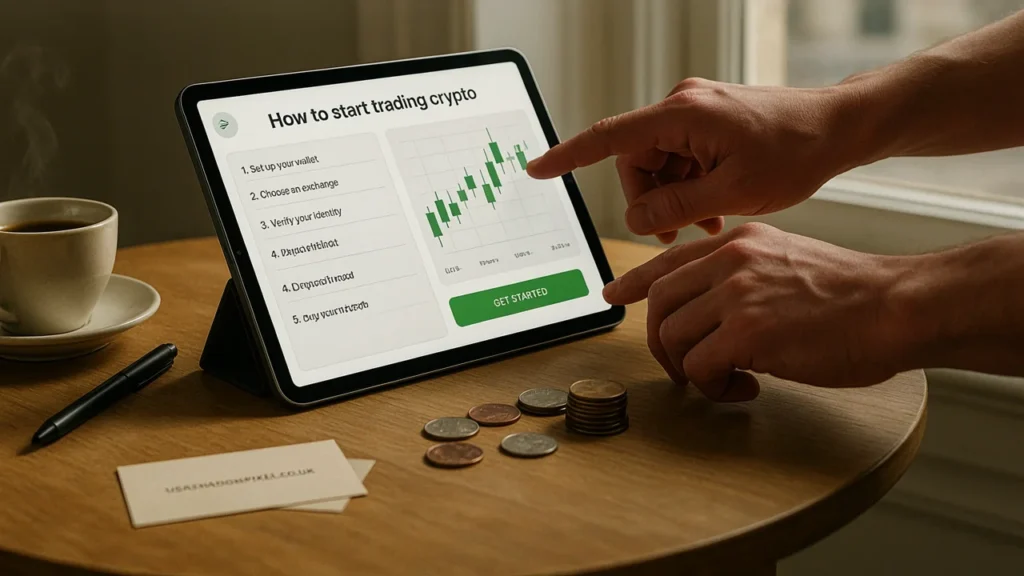
How to Start Trading Crypto in 7 Steps
For beginners, the process can be simplified into seven stages.
1. Learn the Basics Before Trading
Before depositing money, understand the difference between:
- Cryptocurrency coins and tokens
- Bitcoin and altcoins
- Stablecoins and volatile cryptoassets
- Spot trading and derivatives
- Centralized exchanges and decentralized exchanges
- Market and limit orders
- Trading fees and network fees
- Hot wallets and cold wallets
You should also understand market capitalization. A cryptocurrency’s market capitalization generally reflects its market price multiplied by its circulating supply.
Do not assume that a low-priced coin is automatically cheaper or has more potential than Bitcoin or Ethereum. The number of coins in circulation matters when comparing market values.
2. Choose a Cryptocurrency Exchange
A cryptocurrency exchange gives you a platform to buy and sell digital assets.
In the U.S., beginners may encounter platforms and services such as Coinbase, Robinhood, Gemini, and Webull, although available assets, products, fees, and features can vary by jurisdiction and change over time.
When comparing a crypto exchange, look at:
- Available cryptocurrencies
- Trading fees
- Spreads
- Deposit and withdrawal methods
- Security features
- Customer support
- Available order types
- Transfer and network fees
- Whether advanced trading tools are available
- Whether derivatives are offered and whether you are eligible to use them
Fees deserve particular attention. Coinbase, for example, says its trading fees can depend on factors including order type, size, market conditions, asset, payment method, and jurisdiction. Its Advanced platform uses maker and taker pricing.
Robinhood also uses different crypto fee structures depending on routing and trading volume.
Never select a platform simply because an advertisement promises exceptionally high returns or “guaranteed” profits. Regulators specifically warn about crypto trading scams and unrealistic return claims.
3. Open and Secure Your Account
Most regulated platforms require identity verification before allowing you to trade.
Use a unique password and enable two-factor authentication (2FA).
Your account security should include:
- A strong, unique password
- Two-factor authentication
- Secure email access
- Device security
- Withdrawal protections where available
- Careful review of login alerts
Never share your password, authentication codes, seed phrase, or private key.
A legitimate trading platform will not need you to reveal your wallet’s private key so that someone can “unlock” your funds.
4. Fund Your Trading Account
Depending on your location and platform, you may be able to fund your account through a bank transfer or another supported payment method.
Before depositing, check:
- Minimum deposit requirements
- Processing time
- Deposit fees
- Withdrawal restrictions
- Bank account restrictions
- Transaction limits
Avoid depositing money that you need for rent, emergency expenses, debt payments, or other essential obligations.
The CFTC’s guidance is straightforward: only speculate with money you can afford to lose.
5. Decide What You Will Trade
Beginners should generally avoid trying to trade dozens of assets at once.
Start by understanding a small number of established assets.
For example, you could research Bitcoin and Ethereum before exploring smaller altcoins.
When researching a cryptoasset, examine:
- What problem the project is attempting to solve
- How the blockchain works
- Token supply
- Market capitalization
- Liquidity
- Transaction speed
- Transaction fees
- Development activity
- Adoption
- Competition
- Regulatory considerations
- Major risks
Do not buy an altcoin merely because its price has recently increased.
The CFTC specifically warns investors about pump-and-dump schemes involving thinly traded digital coins and tokens and advises against buying based solely on social media tips or sudden price increases.
6. Learn How Crypto Orders Work
Two basic order types are especially important.
Market order: An order to buy or sell immediately at available market prices. The final execution price can differ from the price you see before execution.
Limit order: An order that specifies the maximum price you will pay when buying or the minimum price you will accept when selling. The order may not execute if the market never reaches your specified price.
Other order types can include stop orders and stop-limit orders, depending on the platform.
For beginners, understanding the difference between market and limit orders is more important than immediately learning complicated derivatives strategies.
7. Start Small and Track Every Trade
Your first goal should not be making a large profit.
Your first goal should be learning how the market behaves and how your strategy performs.
Keep a trading journal containing:
- Date and time
- Asset
- Entry price
- Position size
- Reason for entering
- Planned exit
- Actual exit
- Profit or loss
- Fees
- What you learned
This turns random trades into a process that you can review.
Which Crypto Trading Strategy Is Best for Beginners?
There is no single strategy that guarantees profits.
Three common approaches are:
| Strategy | Typical Holding Period | Main Idea |
|---|---|---|
| Day trading | Minutes to hours | Trade shorter-term price movements |
| Swing trading | Days to weeks | Capture larger market moves |
| Long-term investing | Months to years | Hold based on longer-term conviction |
Short-Term Crypto Trading
Short-term crypto trading requires more time, discipline, and risk management.
Traders may use:
- Technical analysis
- Support and resistance
- Trading volume
- Moving averages
- Market structure
- Price action
However, technical indicators are not predictions with guaranteed outcomes.
Long-Term Crypto Investment
Long-term crypto investing focuses more on the asset’s underlying network, adoption, use cases, supply economics, and broader investment thesis.
This approach may involve fewer trades and therefore potentially fewer trading decisions, but it does not eliminate cryptocurrency volatility or the possibility of substantial losses. Source: Coursera

What Is Technical Analysis in Crypto?
Technical analysis attempts to study historical price and volume data to identify potential patterns or market conditions.
Common tools include:
- Support and resistance
- Moving averages
- Relative Strength Index (RSI)
- Trading volume
- Trend lines
- Candlestick patterns
A beginner should treat technical analysis as one input rather than a guaranteed forecasting system.
Combining a simple technical framework with position sizing and risk management is generally more useful than filling a chart with dozens of indicators.
How Much Money Do You Need to Start Crypto Trading?
You do not need thousands of dollars to learn the basics.
Some platforms allow very small crypto purchases, meaning you may be able to begin with an amount such as $1. However, the fact that a platform allows a small purchase does not mean that $1 can realistically generate meaningful daily income.
Starting small can be useful because it limits the financial consequences of beginner mistakes.
Your starting amount should be based on your risk tolerance and financial situation, not on a target profit.
Can You Make $100 a Day Trading Cryptocurrency?
Yes, a trader can make $100 on a particular day, but that does not mean you can reliably make $100 every day.
To target $100 in daily profit, you would need to consider:
- Account size
- Expected return
- Trading fees
- Slippage
- Taxes
- Win rate
- Average winning trade
- Average losing trade
- Number of trades
- Market conditions
Trying to force a fixed daily income from a volatile market can encourage overtrading and excessive risk.
There is no guaranteed crypto trading strategy. The CFTC explicitly warns investors to be skeptical of claims that trading systems can produce guaranteed returns.
What Is Crypto Risk Management?
Risk management is arguably more important than choosing the “best” cryptocurrency.
A basic risk-management plan might include:
- Risking only a small portion of your trading capital on an individual trade
- Using predefined exit levels
- Avoiding excessive leverage
- Limiting the number of simultaneous positions
- Keeping emergency funds outside your trading account
- Avoiding emotional trades
- Reviewing losing trades instead of immediately trying to recover losses
Why Is Leverage Dangerous?
Leverage allows you to control a larger position with less capital.
That can increase potential gains, but it also increases potential losses.
The CFTC warns that leverage can amplify losses in virtual currency futures and that traders can potentially lose more than their initial investment in leveraged futures positions.
For someone learning how to start trading crypto, spot trading is generally easier to understand than immediately using leveraged futures.
Do You Need a Crypto Wallet to Trade?
Not necessarily.
When you trade on a centralized exchange, your crypto may initially remain under the platform’s custody.
A crypto wallet gives you greater control over your digital assets.
Hot Wallet vs. Cold Wallet
Hot wallet: A wallet connected to the internet. It is convenient for frequent transactions but has greater exposure to online threats.
Cold wallet: A wallet kept offline or otherwise isolated from internet-connected systems. It can be useful for longer-term cryptocurrency storage.
Your private key is extremely important because it provides the cryptographic authority associated with controlling assets in a wallet.
Never share your private key or recovery phrase.
CEX vs. DEX: What’s the Difference?
A centralized exchange (CEX) is operated by a company that provides trading infrastructure and typically manages much of the user experience.
A decentralized exchange (DEX) generally allows users to trade through blockchain-based smart contracts without relying on a traditional centralized intermediary in the same way.
DEX trading can involve additional considerations such as:
- Network fees
- Slippage
- Smart-contract risks
- Wallet security
- Token liquidity
- Blockchain congestion
Beginners should understand these risks before moving funds into decentralized finance (DeFi).
What Are the Biggest Risks of Crypto Trading?
Crypto trading carries several risks.
Market Volatility
Cryptocurrency prices can move sharply within short periods.
Cybersecurity Threats
Hackers, phishing attacks, malware, compromised accounts, and fraudulent websites can put digital assets at risk.
Liquidity Risk
Some cryptocurrency tokens may have limited trading volume, making it difficult to buy or sell without significantly affecting the price.
Regulatory Risk
Crypto regulations continue to develop.
In the U.S., the SEC issued an interpretation in March 2026 clarifying how federal securities laws apply to certain crypto assets and transactions, while the CFTC joined the guidance. The SEC also proposed a new “Regulation Crypto Assets” framework in August 2026.
Rules can differ significantly between countries.
In the UK, the FCA’s broader cryptoasset regulatory regime is scheduled to take effect on October 25, 2027, with firms preparing for the new framework during 2026 and 2027.
Scam Risk
Be particularly skeptical of:
- Guaranteed returns
- “Secret” trading systems
- Celebrity investment endorsements
- Requests to send crypto directly to strangers
- Fake customer-support accounts
- Pressure to deposit immediately
- Social-media pump groups
Is Crypto Trading Taxable?
For U.S. taxpayers, digital assets are generally treated as property for federal tax purposes. Selling, exchanging, or otherwise disposing of digital assets can create taxable gains or losses, and the IRS requires taxpayers to report applicable digital-asset transactions.
Keep records of:
- Purchase price
- Sale price
- Dates
- Transaction fees
- Transfers
- Exchanges between assets
- Rewards or staking income where applicable
Tax treatment varies by country, so UK traders should consult HMRC guidance and U.S. traders should use current IRS guidance or qualified tax advice.
A Simple Beginner Crypto Trading Plan
If you are completely new, consider starting with this framework:
Week 1: Learn blockchain, cryptocurrency, wallets, exchanges, and order types.
Week 2: Study Bitcoin and Ethereum and learn basic technical analysis.
Week 3: Create a paper-trading or observation routine and record hypothetical trades.
Week 4: If you decide to use real money, start with an amount you can afford to lose and use a clearly defined strategy.
The objective is not to become a professional trader in four weeks. It is to build habits that reduce avoidable mistakes.
Common Crypto Trading Mistakes to Avoid
Avoid these beginner errors:
- Trading with borrowed money
- Using excessive leverage
- Buying because a coin is trending on social media
- Chasing sudden price increases
- Ignoring fees
- Trading without an exit plan
- Putting all your money into one token
- Sharing private keys or recovery phrases
- Believing guaranteed-profit claims
- Trying to recover losses through increasingly larger trades
A good trader does not need to win every trade. The objective is to manage losses and maintain a strategy that can survive unfavorable market conditions.
Is Crypto Trading Worth It for Beginners?
Crypto trading can be worth learning if you understand that it is speculative and you approach it as a skill rather than a guaranteed income source.
The most sensible starting point is education, followed by a small amount of real-world experience and strict risk management.
You do not need to predict every cryptocurrency price movement. You need to understand what you are trading, know how much you can afford to lose, and have a plan before you enter a position.
As the CFTC and FCA emphasize, crypto can involve substantial risk, and investors should not commit money they cannot afford to lose.
Custom FAQ Section
How to start trading crypto for beginners?
Start by learning cryptocurrency basics, choosing a reputable exchange, securing your account, depositing a small amount, learning market and limit orders, selecting a simple strategy, and using strict risk management. Beginners should avoid leverage until they understand how it works.
How to start trading crypto on Reddit?
Reddit can be useful for learning about other traders’ experiences, but it should not be treated as a source of guaranteed trading signals. Research claims independently, verify information through reliable sources, and never send money or cryptocurrency to someone simply because they claim to have a profitable strategy.
How to start trading crypto and make profit?
There is no guaranteed method for making a profit. A sensible approach is to develop a defined strategy, control position size, account for fees and slippage, maintain a trading journal, and evaluate results over many trades rather than judging yourself by one successful trade.
Can I start crypto trading with $1?
Yes, some platforms allow users to purchase very small amounts of cryptocurrency. However, $1 is primarily useful for learning how transactions and orders work. It is not a realistic amount for reliably generating meaningful daily income.
Can I make $100 a day trading cryptocurrency?
It is possible to make $100 on an individual trading day, but consistent $100 daily profits are not guaranteed. Attempting to force a fixed daily income can encourage excessive trading and risk-taking.
How to day trade crypto for beginners?
Learn market and limit orders first, study basic price action and volume, choose a liquid market, create entry and exit rules, and start with very small positions if you use real money. Avoid high leverage while learning.
Read more………