
Street Fighter Games in Order
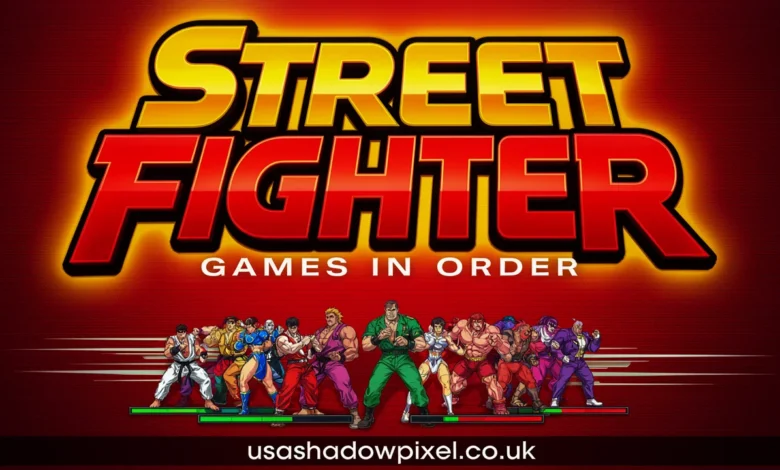
The Street Fighter series began with Street Fighter in 1987 and continues today with Street Fighter 6 (2023). The main entries in release order are Street Fighter, Street Fighter II, the Alpha trilogy, Street Fighter III, Street Fighter IV, Street Fighter V, and Street Fighter 6.
There is a catch: “chronological” can mean two things. Release order is when Capcom shipped each game. Story order is when each game happens inside the fiction, and the two don’t line up. This guide covers both, explains the updates that make the list look bigger than it is, and helps you decide where to jump in.
How Many Street Fighter Games Are There?
There are about nine core entries: Street Fighter, three Alpha games, Street Fighter II, III, IV, V, and 6. The count balloons once you add special editions, ports, and collections. Street Fighter II alone has more than half a dozen versions, and IV and V each got several upgrades.
The simplest way to stay oriented is to treat each numbered generation as one “era” and each update as a refined version of that era.
Street Fighter Games by Release Date
| Year | Game | Why it matters |
|---|---|---|
| 1987 | Street Fighter | The arcade original that introduced Ryu and Ken |
| 1991 | Street Fighter II: The World Warrior | The breakout hit that defined the fighting game genre |
| 1992–1994 | Champion Edition, Hyper Fighting, Super, Super Turbo | Rebalanced sequels and special versions |
| 1995 | Street Fighter Alpha: Warrior’s Dreams | Start of the Alpha subseries |
| 1996 | Street Fighter Alpha 2 | Refined the Alpha formula |
| 1997 | Street Fighter III: New Generation, 2nd Impact | Entirely new cast, parry system |
| 1998 | Street Fighter Alpha 3 | The largest classic-era roster |
| 1999 | Street Fighter III: 3rd Strike | The final III release, still played competitively |
| 2008–2009 | Street Fighter IV | 2D gameplay with 3D visuals; revived the genre |
| 2010–2014 | Super, Arcade Edition, Ultra Street Fighter IV | Long-running upgrade cycle |
| 2016 | Street Fighter V | Seasonal content and online-first design |
| 2018–2020 | Arcade Edition, Champion Edition | Final V versions |
| 2023 | Street Fighter 6 | Modern Control, World Tour, the Drive System |
The Street Fighter Games in Chronological Order, One by One
Street Fighter (1987)
The first game was a fairly clunky arcade fighter. Some cabinets used pressure-sensitive pads, so how hard you hit determined how strong the punch was. It still gave the franchise its foundations: Ryu, Ken, one-on-one fights, and Sagat as the final boss.
Street Fighter II and Its Special Editions (1991–1994)
Street Fighter II: The World Warrior arrived in 1991 and made fighting games a mainstream arcade fixture. It introduced the six-button layout, motion inputs for special moves, and combos, and its eight-fighter lineup included Chun-Li, Guile, Zangief, and Dhalsim. Four bosses, including M. Bison, Sagat, Balrog, and Vega, guarded the finish.
Capcom then kept refining it:
- Champion Edition (1992): Made the bosses playable.
- Hyper Fighting (1992): Sped the game up.
- Super Street Fighter II (1993): Added new fighters such as Cammy and Fei Long.
- Super Street Fighter II Turbo (1994): Added Super Combos and the hidden Akuma.
Street Fighter Alpha Series (1995–1998)
The Alpha games take place between the original game and Street Fighter II. They introduced Charlie, Rose, and Dan Hibiki, and later Sakura, Karin, and Rainbow Mika. The art style was more anime-inspired, and Alpha 3 in 1998 ended the subseries with a huge cast and flexible fighting styles.
Street Fighter III (1997–1999)
Capcom’s boldest reset replaced most of the familiar cast with Alex, Yun, Yang, Ibuki, Sean, Dudley, and the Illuminati leader Gill. The key mechanic was the parry, a timing-based defensive move. The game sold modestly at first, but 3rd Strike became a competitive-scene fixture, and the famous “Evo Moment #37” parry sequence from 2004 helped cement its legacy.
Street Fighter IV (2008–2014)
Street Fighter IV brought the series back to 2D gameplay with 3D graphics in 2008 and pulled a new generation into the fighting game scene. It added Focus Attacks, Ultra Combos, and new faces such as Abel and Crimson Viper, and Seth served as the final boss. Super, Arcade Edition, and Ultra kept the game alive for years.
Street Fighter V (2016)
Street Fighter V launched in 2016 with a small roster and a rocky start, then gained new fighters like Rashid, F.A.N.G, Necalli, and later Luke through seasonal DLC. Its final version, Champion Edition, arrived in 2020.
Street Fighter 6 (2023)
Street Fighter 6 launched on June 2, 2023 with 18 fighters and three main modes:
- Fighting Ground: the traditional versus and arcade experience
- World Tour: a story-driven, open-world mode with custom avatars
- Battle Hub: an online social space
It also added Modern Control, a simplified scheme that lowers the barrier for beginners, alongside the Drive System that governs offense and defense. It earned Best Fighting Game at The Game Awards 2023. Source: Siliconera
What Is the Story Order of the Street Fighter Games?
Story order differs from release order, mainly because Capcom went back in time twice:
- Street Fighter (the first World Warrior tournament)
- Street Fighter Alpha series (the gap between the first game and II)
- Street Fighter II (the second tournament and the Shadaloo conflict)
- Street Fighter IV (set between II and III)
- Street Fighter V (also before III)
- Street Fighter III (the Illuminati era, with Alex as protagonist)
- Street Fighter 6 (set after the Street Fighter III games and the latest title on the official timeline)
This is why Street Fighter IV and V feel like “prequels” even though they are newer games. Capcom did the same for the Alpha series. It also explains why Street Fighter 6 doesn’t follow directly from V, even though V ends with Luke as a setup.
What Year Does Street Fighter 6 Take Place?
Capcom hasn’t given an exact year. Most earlier games sit in the 1990s, and since the returning characters aren’t dramatically older, it is reasonable to assume an early-to-mid 2000s setting. That’s a fan inference, not an official date.
Street Fighter Spin-Offs and Crossover Games
Spin-offs and crossovers are usually excluded from the main list. The notable ones include:
- Street Fighter EX series (1996 onward): an early 3D take by Arika, generally treated as non-canon.
- Pocket Fighter and Super Puzzle Fighter II Turbo: lighthearted spin-offs with a puzzle or chibi style.
- Marvel vs. Capcom and Capcom vs. SNK series: the “Vs. series” crossover games.
- Street Fighter X Tekken (2012): a tag-team crossover with Namco’s franchise.
- Street Fighter 2010: The Final Fight (1990): a platformer that has little to do with the fighting series.
- Compilations: the Street Fighter 30th Anniversary Collection (2018) and Ultra Street Fighter II: The Final Challengers on Nintendo Switch (2017) are the easiest ways to play the classics today.
Which Street Fighter Game Should You Play First?
Start with Street Fighter 6 if you want to play with others. It has the biggest active community, a strong tutorial, and Modern Control for newcomers. World Tour also works as an extended introduction to the wider cast.
If you’re curious about history, try the 30th Anniversary Collection to sample the classics, then come back to the modern game. If story is your priority, follow the story order above and skip the spin-offs.
What Comes Next for Street Fighter?
Street Fighter 6 is still being expanded. Year 3 brought Sagat, C. Viper, Alex, and Ingrid, with Ingrid arriving on May 28, 2026. Then at Summer Game Fest 2026, Capcom announced Tifa Lockhart from Final Fantasy 7, plus Bosch, Yasmine, and Arjun for Season 4. The release schedule is Yasmine on August 3, Arjun in autumn 2026, Tifa in early 2027, and Bosch in spring 2027, and it is the first season with no returning characters.
The franchise is also heading to cinemas. Paramount’s Street Fighter film is scheduled for release in the United States on October 16, 2026. Capcom hasn’t announced a successor to Street Fighter 6, and given how long previous games stayed supported, a new numbered entry seems some way off.
Street Fighter Games FAQs
Street Fighter games in chronological order on Reddit: what do fans usually recommend?
Fan discussions, including Reddit threads, tend to settle on two answers. Play in release order if you want to see how the gameplay evolved, and follow the story order if you care about the lore. Neither is required, since each game is playable on its own.
What are all the Street Fighter games in order?
The main games in order are Street Fighter (1987), Street Fighter II (1991), Street Fighter Alpha (1995), Alpha 2 (1996), Street Fighter III (1997), Alpha 3 (1998), III: 3rd Strike (1999), Street Fighter IV (2008), Street Fighter V (2016), and Street Fighter 6 (2023).
What is the order of Street Fighter games by release date?
Release order runs from 1987 to 2023 as listed in the table above. Special editions such as Super Street Fighter II Turbo and Ultra Street Fighter IV count as updates within their generation.
What year does Street Fighter 6 take place?
No official year has been confirmed. It takes place after Street Fighter III, which puts it in the early-to-mid 2000s by most fan estimates.
Which Street Fighter game should you play first?
Street Fighter 6. It’s the most active, has strong tutorials, and includes Modern Control for beginners.
Is Street Fighter 6 the latest game?
Yes. It remains the newest mainline entry and is still receiving DLC through its Year 4 lineup.
Read more……….